
The Model Was the Point
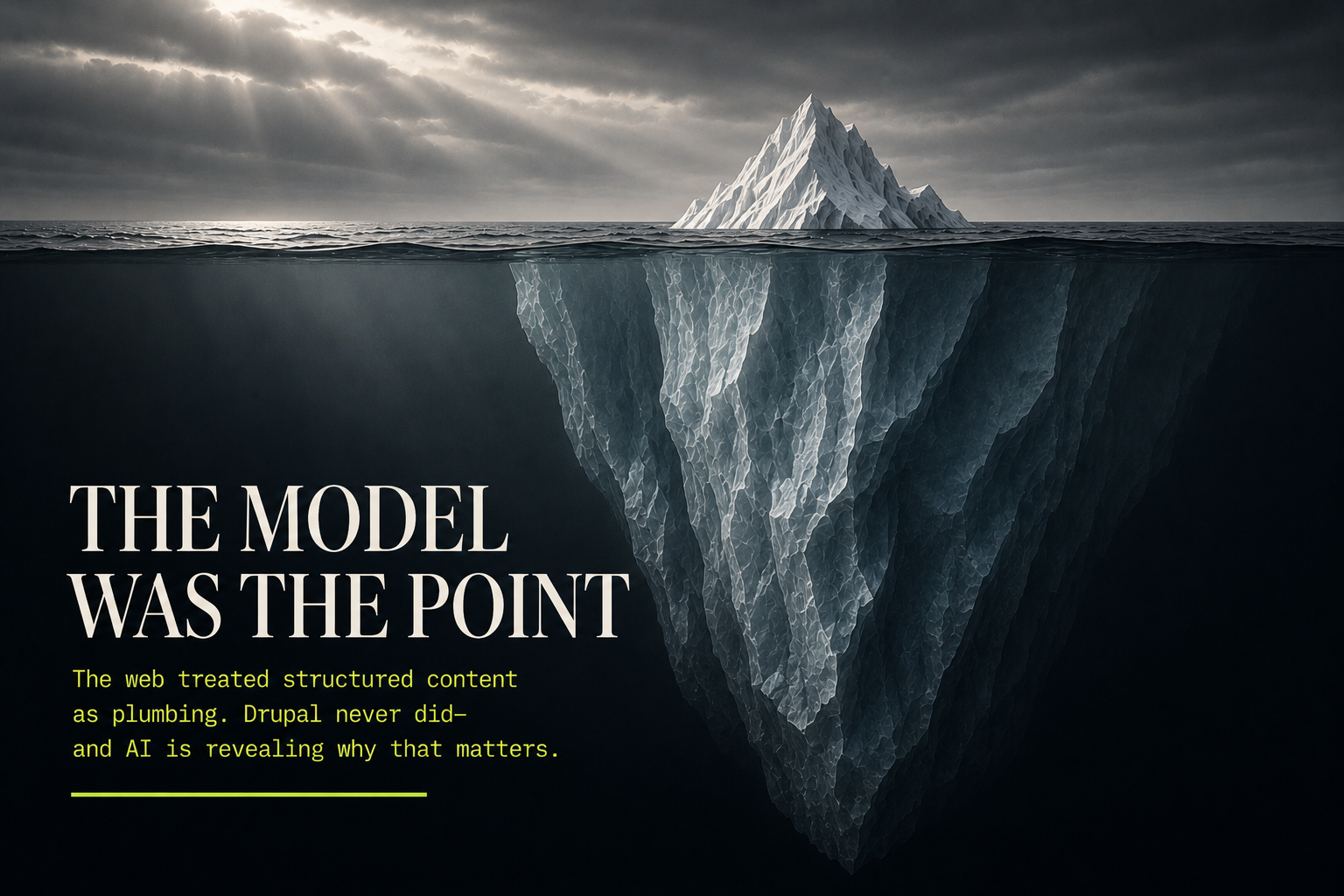
The web treated structured content as plumbing. Drupal never did — and AI is revealing why that matters.
For years, Drupal's greatest strength was often described as its greatest weakness.
Entities, fields, relationships, taxonomies, revisions, workflow states, granular permissions — all the machinery required to model an organization's information in a system rather than in a developer's head. Set next to a thinner platform that stored content and returned clean JSON, all of it could look like ceremony. A heavier, slower, more demanding way to build a website.
Meanwhile, the web's most celebrated work moved toward the interface. Frameworks got faster. Frontends got richer. Rendering moved from the server to the browser, back to the server, and out to the edge as the field argued out the tradeoffs. Component systems turned frontend development into something close to industrial design. The presentation layer attracted the talent, the attention, and the budgets. It became the place ambitious engineers wanted to be.
Drupal kept insisting that the model underneath mattered.
AI is making it much easier to see why.
This is not an argument that the frontend era was a mistake, or that one tool beat another. It's an argument that the industry quietly bet on the wrong layer — that it treated the content model as interchangeable infrastructure at exactly the moment it was becoming the most valuable thing a serious organization owns. Drupal is the clearest platform-level evidence, but the reversal is bigger than Drupal, and it's worth following all the way down.
The complexity didn't disappear. It moved.
The appeal of the thin, frontend-first stack was simplicity: strip the content system down to an API and let the presentation layer do the interesting work. But the simplicity was partly a trick of where you were looking. The complexity of modeling a real organization's information didn't vanish when the CMS got thinner. It relocated.
A relationship the platform didn't represent reappeared in application code. A missing editorial state became a naming convention everyone agreed to honor. A weak taxonomy became a rule buried in the search index. A business definition lived inside an integration. An audience distinction got encoded in a frontend conditional. A content dependency was tracked in a spreadsheet three teams quietly relied on.
The platform looked simpler because less of the organization had been formally described inside it. But the organization hadn't gotten any simpler. Its people still belonged to departments. Its policies still superseded earlier policies. Its publications still had authors, rights, and corrections. Different users were still entitled to see different things. The complexity didn't leave. It scattered — across codebases, services, conventions, and institutional memory.
And that arrangement worked. It worked well, for a long time, because of one quiet fact that the AI era is about to make impossible to ignore.
The semantic layer was the people.
The scattered model held together because humans held it together. A developer looked at an API response and knew that department_id pointed at a separate service. An editor saw a page marked "archived" and knew to keep it out of current guidance. A staffer knew that two nearly identical records were actually two different regional programs. The relationships that weren't declared in the system were declared in someone's head.
The organization had a semantic layer the whole time. It just wasn't in the technology. The semantic layer was its people — and people are extraordinary at this. We compensate for missing structure so automatically we don't notice we're doing it. A sophisticated frontend could sit on top of an impoverished model indefinitely, because the humans assembling the output supplied everything the model left out.
The weakness underneath was real. It was simply invisible, because the thing covering for it was so good at the job that no one had to name it.
Plausibility is not authority.
Generative AI looks, at first, like the final argument against formal structure. A model can read your documents, extract the names, infer the likely relationships, summarize the policies, classify the content, and answer questions across information nobody ever carefully modeled. It finds patterns where older software demanded a schema. So why model an institution for years when a model can reconstruct the meaning on demand?
For a great many tasks, that's a real question with a comfortable answer: don't bother. Draft the paragraph, suggest the tag, summarize the page. The work is low-stakes and a human is right there to catch a miss.
But push toward the work institutions actually depend on, and the comfortable answer runs out. Take a university. An AI system could read the program pages, faculty bios, policy PDFs, course catalogs, and departmental sites, and from all of it infer that two differently named programs are the same degree, that a newer financial-aid document supersedes an older one, that a professor sits in a particular department, that a policy applies only to graduate students. It can build a plausible shadow of the university every time someone asks it something.
But plausibility is not authority. The university still needs somewhere to declare that these two programs are the same one, that this policy is the current one, that this person holds this role, that this requirement governs this population, that this record may be seen by this audience and not that one. For a promotional paragraph, the plausible shadow is fine. For a financial-aid determination, a compliance answer, a medical instruction, a public-records response — the gap between inferred structure and declared truth is the entire system.
This is the distinction the whole reversal turns on, so it's worth stating precisely, because an AI-literate skeptic will press exactly here. The point is not that models can't infer structure — they infer it constantly and impressively; that's why the objection is serious. The point is that an institution can't always treat inferred structure as authoritative. A model can fill the gaps. The institution still has to decide when a filled gap is reliable enough to act on — and the more consequential the action, the less an institution can afford to have that decision made silently, fresh, every time the question is asked. A chatbot summarizing a page can live with ambiguity. An agent acting across institutional systems often cannot afford to.
AI doesn't remove the need for an explicit, governed model of your information. It removes your ability to pretend you didn't need one.
What looked like weight was information architecture.
Which brings the argument back to the platform that never stopped taking that layer seriously. That platform is Drupal — and the reframing this essay is really about is what happens when you look at Drupal's so-called weight through the eyes of the new reader.
Drupal's architectural bet was never that a website needed a more elaborate place to store text. It was that a serious digital platform needs an explicit model of the world it represents. It describes different kinds of things as distinct entities, gives them fields and declared meaning, lets you state how they relate, classify them, version them, assign ownership, attach permissions, and move them through workflow states. A university platform can hold that people belong to departments, departments offer programs, programs contain courses, policies govern audiences. A government platform can distinguish services, agencies, legislation, notices, officials, benefits, and eligibility. A publisher can model articles, editions, authors, rights, corrections, and syndication.
Look at that machinery again with the previous section in mind. Fields are declared semantics — the system saying what things mean instead of leaving a model to guess. Relationships are the organization's actual shape, made explicit. Taxonomy is shared classification. Revisions are provenance. Workflow state is a signal about what's authoritative. Permissions are boundaries on what may be retrieved and what may be acted upon. None of that is excess weight. It's a machine-readable map of what an organization knows, how that knowledge connects, which version is true, who may use it, and what may be done with it.
It was always that map. It was simply answering a question — how do you build an institutional platform that stays coherent across years, teams, regions, and technology changes? — that the market had temporarily decided was less interesting than how fast can you ship an interface? What got called weight was the visible, upfront cost of making institutional meaning explicit. Every serious platform eventually pays that cost. Drupal's distinction was forcing those decisions into the open early and deliberately, rather than letting them surface later and by accident, scattered through application logic and editorial workarounds.
A page is one presentation of that model. An API is another. A search index is another. An AI agent is simply the newest consumer to walk up to the same model — and find that the platform can explain not just what it contains, but what that information means.
The turn
For years, organizations looked at all those entities and fields and workflows and saw a heavier way to build a website.
An AI agent looks at the same architecture and sees something else entirely: a declaration of what exists, how it relates, which version is authoritative, who may use it, and what may be done with it.
The architecture did not change. The reader did.
People and applications could always compensate for a thin model, because they carried the missing meaning around outside the system. An agent can infer some of that meaning too — but inference is not a substitute for the institution declaring what is authoritative. The platforms that made the implicit explicit were not just documenting their content. They were making the organization legible to software. In that sense, they had been keeping careful notes for a reader nobody knew was coming.
The structure makes the AI useful. The AI makes the structure usable.
There's a second movement to this, and it's the part that makes the moment more than a vindication.
Drupal's power has always carried a cost on the other side too — not just the modeling discipline, but the learning curve. Entities, fields, Views, vocabularies, displays, workflows, roles, configuration: the flexibility is real, and so is the number of concepts a person had to master to wield it. That cost is a large part of why the platform's depth so often stayed locked up in the hands of specialists.
AI changes both sides of that equation at once. The structured model gives an agent something reliable to reason against — so Drupal makes the AI more capable. And the agent gives a person a way to work through that structure by intent rather than by mastery — so the AI makes Drupal more reachable. Describe an outcome: build a multilingual publication workflow, assemble a page from approved components, classify these documents into the existing taxonomy, find everything a policy change affects. The agent operates against the explicit model; the person doesn't have to hand-operate every layer of it first.
So the structure makes the AI useful, and the AI makes the structure usable. That's not "Drupal was right." It's a reason the architecture that was hard to adopt could become dramatically easier to reach — which is a forward-looking claim, not a backward-looking one.
What this does and doesn't claim
Two honest boundaries, because the argument is easy to over-read.
It isn't a claim that every site should have been built this way. The brochure site, the campaign microsite, the disposable interface over a simple feed — for those, the thin model was the right call and the rich one would have been genuine overkill. The claim is narrower and harder to dismiss: the industry applied the thin-model default well past the boundary where it stopped being appropriate — to universities, agencies, health systems, publishers, regulated enterprises whose information was never actually simple — because the cost of getting it wrong stayed hidden as long as humans were the only ones reading.
And it isn't a claim that connecting a model to a structured platform makes it intelligent. Drupal can be modeled badly: information duplicated, fields misused, meaning buried in page-builder layouts, essential rules encoded in custom code no one understands. AI doesn't fix that — a weak model wired to an agent just distributes its confusion at machine speed, which is worse. The advantage shows up only where the architecture was used as intended: durable concepts modeled, real relationships declared, change governed, information kept separate from any single presentation. That takes accountable judgment. AI can recommend, infer, and evaluate — but it cannot own the institutional consequences of a decision.
What's being vindicated isn't any particular implementation. It's the bet underneath the architecture — that a serious digital system is built on structured, governed, reusable information, not on the interface alone.
The layer beneath every interface
The first era of the web made publishing accessible to anyone. The frontend era made interfaces programmable, dynamic, and increasingly independent of the systems behind them. AI is now making interpretation, generation, and interface creation abundant too — soon an organization may spin up dozens of interfaces for different audiences, devices, agents, and moments without hand-building any of them.
All of them will still need to know what is true.
That's the layer that doesn't get cheaper. An authoritative model of what an organization knows — its people, programs, services, policies, relationships, permissions, states, and history — can't be replaced by a plausible answer assembled at the instant someone asks. It has to exist before the question, persist after the interface changes, and stay accountable to the institution it represents.
For much of the modern web era, the value of building that layer deliberately was easy to underestimate. The cost came first and the payoff came later, and in a decade that prized speed and inexpensive interfaces, a benefit you could not yet see was hard to tell apart from a tax.
AI makes that benefit legible. Not by rescuing Drupal, and not by making structure newly important, but by creating a new class of reader that needs the system to explain itself — and works best when it can.
The interface was never the whole platform.
The model was the point.