
Drupal Simple OAuth + Next.js: Complete SSO Implementation
Authentication is one of those topics that sounds simple until you actually implement it.
Most teams begin with a straightforward goal:
Allow users to log in.
A few weeks later they’re troubleshooting:
- Invalid grants
- Refresh token failures
- CORS errors
- Session expiration problems
- PKCE issues
- Production deployment inconsistencies
Authentication is rarely difficult because of code.
It’s difficult because there are many moving parts.
And every one of them matters.
This article explains how I approach Single Sign-On (SSO) between Drupal 11 and Next.js using:
- Simple OAuth
- Authorization Code Flow
- PKCE
- Refresh Tokens
- Modern security practices
The goal isn’t merely getting authentication working.
The goal is building an authentication system that remains reliable in production.
Understanding The Architecture
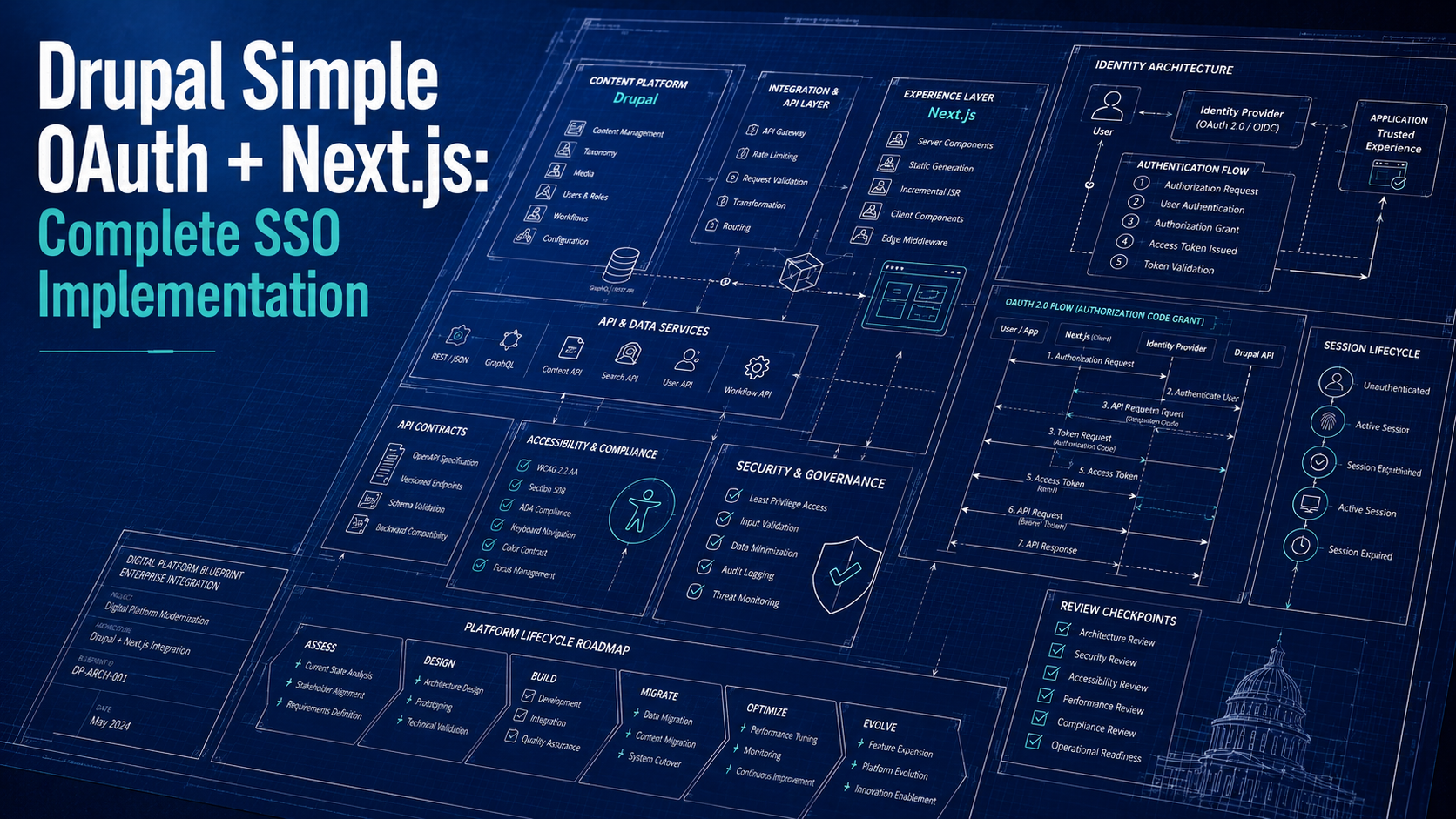
A modern implementation typically looks like this:
- text id="ax92qm" User ↓ Next.js ↓ Drupal OAuth Server ↓ Protected APIs
Drupal becomes the identity provider.
Next.js becomes the client application.
Authentication is delegated to Drupal.
Authorization tokens are then used to access protected resources.
This creates a clean separation of responsibilities.
Why OAuth Instead Of Custom Authentication?
Many organizations initially consider building custom authentication.
I generally advise against it.
OAuth already solves:
- Authorization
- Token management
- Session handling
- Refresh workflows
- Security concerns
Recreating these systems introduces unnecessary risk.
The best authentication system is often the one you don’t have to invent.
Why PKCE Matters
Historically, Authorization Code Flow assumed applications could safely store secrets.
Modern applications often cannot.
Examples include:
- Single Page Applications
- React applications
- Mobile applications
- Next.js frontend experiences
PKCE solves this problem.
Instead of relying on a client secret, the application generates:
- Code Verifier
- Code Challenge
The authorization server validates the relationship.
This significantly improves security for public clients.
Installing Simple OAuth
Install the module:
- bash id="j6wzlr" composer require drupal/simple_oauth
Enable it:
- bash id="1o0z5v" drush en simple_oauth
Then generate encryption keys.
These keys become part of your authentication infrastructure.
Protect them carefully.
Treat them like production credentials.
Because they are.
Create An OAuth Client
Once Simple OAuth is installed:
Create a client.
Typical configuration includes:
Client Name
Example:
- text id="xv5t5q" Next.js Frontend
Redirect URI
Example:
- text id="w36jnh" https://app.example.com/api/auth/callback
Grant Type
Authorization Code
PKCE
Enabled
This becomes the foundation of the integration.
Next.js Authentication Strategy
Many authentication tutorials immediately jump into implementation details.
Before doing that, decide:
Who owns identity?
In this architecture:
Drupal owns identity.
Drupal is responsible for:
- User accounts
- Passwords
- Permissions
- Roles
Next.js consumes identity.
This distinction prevents significant complexity later.
Authentication Flow
A simplified flow looks like this:
text id="w0wdv7" User clicks Login ↓ Drupal Login Page ↓ Authentication ↓ Authorization Code ↓ Token Exchange ↓ Access Token ↓ Authenticated Session
The frontend never handles passwords directly.
This is important.
Access Tokens
After authentication, Drupal issues an access token.
Example responsibilities:
- API authorization
- User identification
- Protected resource access
Access tokens should be treated as temporary credentials.
Because that’s exactly what they are.
Refresh Tokens
One of the most common mistakes I encounter involves refresh tokens.
Teams often:
- Ignore them
- Misconfigure them
- Fail to store them securely
Then users get logged out unexpectedly.
A Better Approach
Access Token:
- text id="jlwmzl" Short lifetime
Refresh Token:
- text id="v8i2gt" Longer lifetime
When the access token expires:
Use the refresh token.
Issue a new access token.
Maintain the session.
This creates a significantly better user experience.
Secure Storage
Storage decisions matter.
For web applications:
- Consider:
- Secure cookies
- HttpOnly cookies
- Encrypted storage approaches
Avoid exposing sensitive credentials unnecessarily.
The goal is minimizing attack surface.
Not maximizing convenience.
Protecting API Routes
A common mistake:
Authentication exists.
Authorization does not.
These are different concerns.
Questions include:
Is the user authenticated?
Is the user allowed to perform this action?
Drupal roles and permissions should remain the source of truth.
Do not duplicate authorization rules unnecessarily.
Session Restoration
Many applications work perfectly until the browser refreshes.
Then everything breaks.
A healthy implementation should support:
Browser Refresh
Session Persistence
Token Refresh
Reauthentication
Users should not need to log in repeatedly throughout the day.
Handling Logout Correctly
Logout sounds simple.
It rarely is.
A complete logout process should:
Destroy Local Session
Remove Tokens
Invalidate Server Session (If Appropriate)
Redirect Predictably
Partial logout implementations often create confusing user experiences.
Common Production Problems
Over time, the same issues appear repeatedly.
Problem #1
Redirect URI Mismatch
Example:
- text id="vwjq80" Expected: /callback
Received:
- text id="1az0h3" /callback/
Authentication fails.
OAuth is strict.
Problem #2
Incorrect PKCE Implementation
Code verifier mismatch.
Authorization failure.
Authentication loop.
These symptoms often indicate PKCE issues.
Problem #3
Broken Refresh Logic
Login succeeds.
Several hours later:
Users are logged out unexpectedly.
Refresh flow usually deserves investigation.
Problem #4
CORS Misconfiguration
The OAuth server works.
The browser blocks requests.
Developers blame authentication.
The browser is actually the issue.
Problem #5
Role Synchronization Issues
Authentication succeeds.
Authorization fails.
The user exists.
Permissions do not align.
Authentication and authorization must be evaluated separately.
Security Checklist
OAuth
- Authorization Code Flow
- PKCE enabled
Tokens
- Access tokens short-lived
- Refresh tokens managed securely
Storage
- Secure cookies
- Sensitive data protected
Infrastructure
- HTTPS enforced
- Secrets managed securely
Authorization
- Drupal remains source of truth
- Roles reviewed regularly
Common Mistakes
Mistake #1
Using Custom Authentication
OAuth already solves this problem.
Mistake #2
Ignoring PKCE
Modern public clients should use PKCE.
Mistake #3
Poor Refresh Token Strategy
Authentication should survive normal usage patterns.
Mistake #4
Treating Authentication And Authorization As The Same Thing
They are not.
Mistake #5
Planning Security Later
Security architecture should exist before implementation begins.
Production Readiness Checklist
Drupal
- Simple OAuth configured
- Keys generated securely
- OAuth client configured
Next.js
- Authentication flow implemented
- Session management implemented
- Refresh flow implemented
Security
- HTTPS enabled
- Secrets protected
- Cookies secured
Operations
- Logging configured
- Monitoring configured
- Failure scenarios tested
Final Thoughts
Authentication systems succeed when they’re boring.
Users shouldn’t think about them.
Developers shouldn’t constantly troubleshoot them.
The best implementations are:
- Secure
- Predictable
- Maintainable
Drupal Simple OAuth and Next.js provide an excellent foundation for achieving that goal.
But success depends less on the technology and more on the architecture surrounding it.
PKCE.
Token management.
Session handling.
Authorization strategy.
Those decisions determine whether authentication becomes a strength or a recurring source of production incidents.
Build them carefully.
Need Help Implementing Drupal SSO?
DrupalRX helps organizations design OAuth architectures, PKCE implementations, Next.js integrations, mobile authentication systems, and secure API workflows.
If your authentication system feels fragile, start with an architecture review before adding more complexity.