
Drupal vs Contentful vs Sanity vs Strapi: A Practitioner’s Comparison
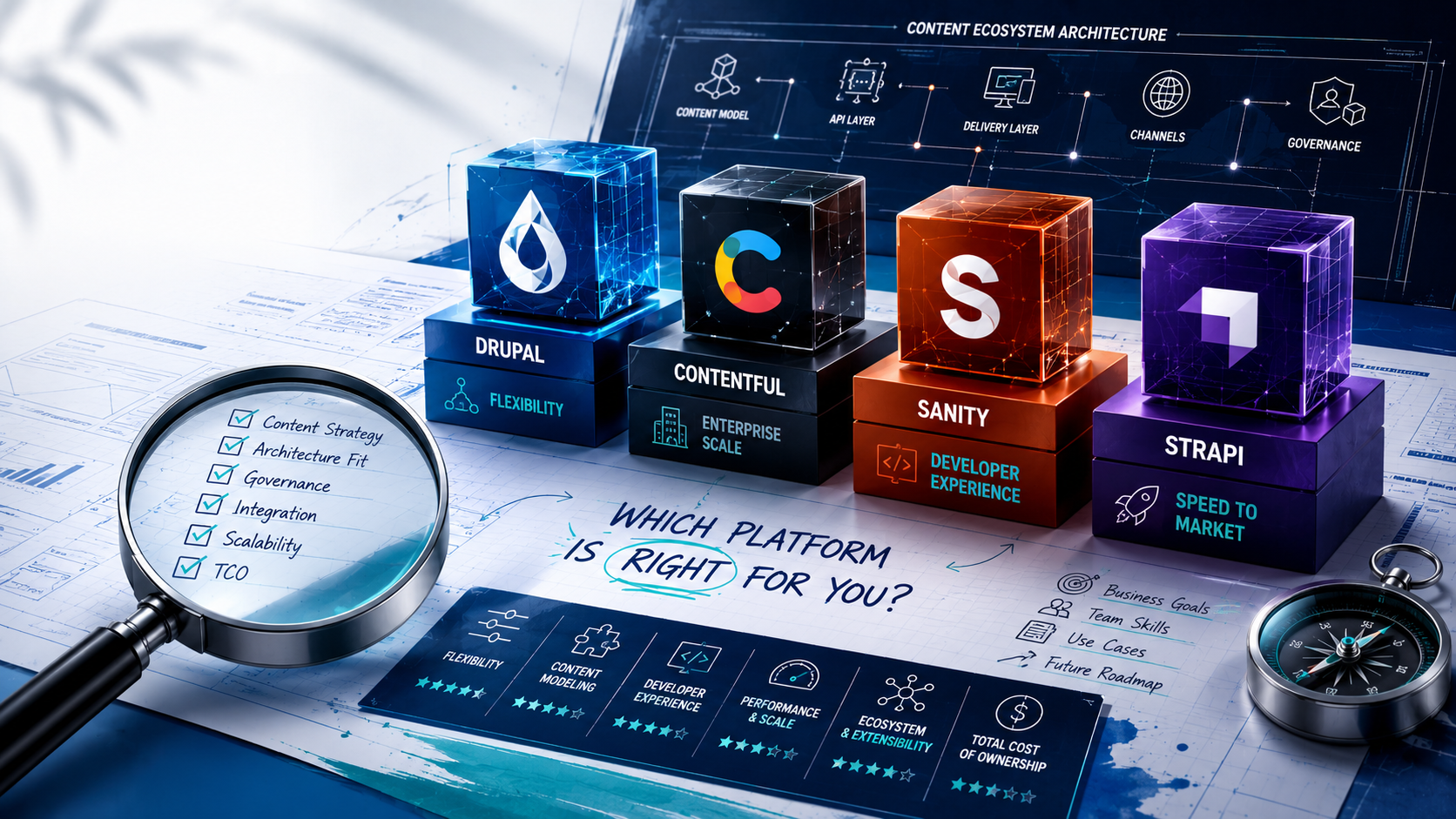
Drupal vs Contentful vs Sanity vs Strapi
Every few months someone asks:
- “Why would anyone choose Drupal when Contentful, Sanity, and Strapi exist?”
It’s a fair question.
The CMS landscape has changed dramatically.
Organizations now have more choices than ever.
Years ago, the conversation was often:
- Drupal vs WordPress
Today the conversation is increasingly:
- Drupal vs Contentful
Drupal vs Sanity
Drupal vs Strapi
And honestly, that’s a much more interesting discussion.
Because these platforms solve similar problems in very different ways.
The mistake many organizations make is assuming there is a universal winner.
There isn’t.
The correct choice depends on the complexity of the organization, the content model, governance requirements, team composition, and long-term strategy.
Let’s compare them from an architectural perspective.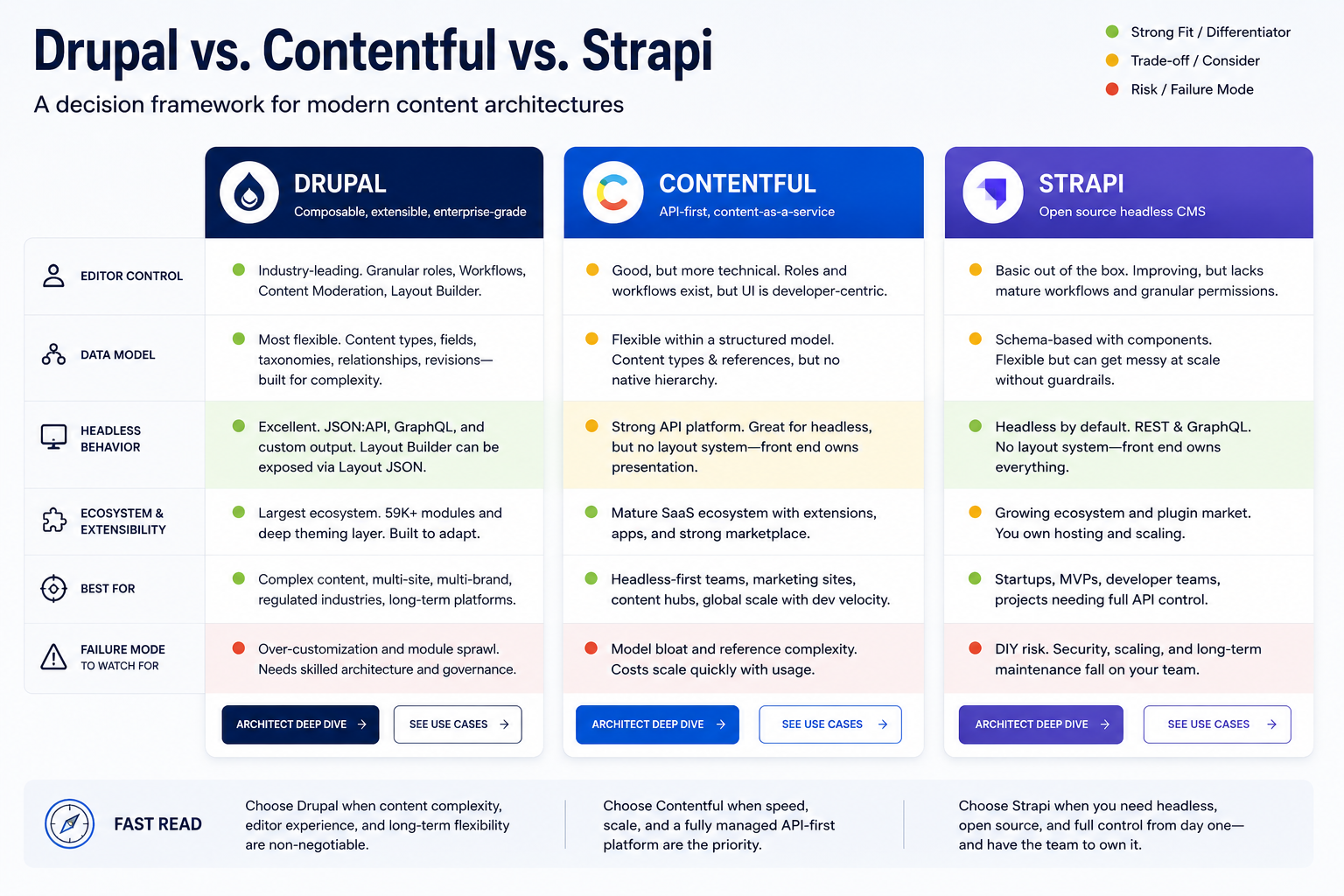
The First Question Nobody Asks
Most platform evaluations begin with features.
That’s usually a mistake.
The first question should be:
What problem are we actually solving?
Because these platforms were designed for different realities.
A startup launching a product website has different needs than:
- A federal agency
- A university
- A healthcare network
- A media organization
Architecture should reflect reality.
Not trends.
Drupal
Let’s start with Drupal.
Drupal’s strength is not simplicity.
Drupal’s strength is complexity management.
It excels when organizations need:
- Structured content
- Governance
- Permissions
- Editorial workflows
- Complex relationships
- Large-scale content operations
Drupal was designed for organizations.
Not just websites.
Where Drupal Excels
Content Relationships
Drupal handles complex relationships exceptionally well.
Governance
Permissions and workflows are mature.
Structured Content
Entity architecture remains one of Drupal’s greatest strengths.
Enterprise Requirements
Large organizations often fit naturally into Drupal’s model.
Open Source Flexibility
Organizations maintain ownership and control.
Where Drupal Struggles
Learning Curve
Drupal requires investment.
Developer Onboarding
Finding experienced Drupal talent can be harder.
Simplicity
For small projects, Drupal may be unnecessary.
Contentful
Contentful helped popularize the modern headless CMS movement.
It focuses heavily on content delivery through APIs.
Contentful’s core idea is:
Content infrastructure.
This approach appeals strongly to product organizations.
Where Contentful Excels
API-First Experience
Excellent developer experience.
Cloud Simplicity
Minimal infrastructure management.
Fast Startup Velocity
Teams can move quickly.
Modern Frontend Ecosystems
Excellent fit for React, Next.js, and modern applications.
Where Contentful Struggles
Governance Complexity
Large organizations sometimes encounter limitations.
Cost
Pricing becomes significant at scale.
Customization
Organizations operate within platform constraints.
Ownership
You’re investing in a SaaS platform rather than owning the entire stack.
Sanity
Sanity approaches content differently.
It combines:
- Structured content
- Developer-focused customization
- Flexible editorial experiences
Many developers love Sanity because it feels modern and highly customizable.
Where Sanity Excels
Developer Experience
One of the strongest experiences available today.
Flexible Content Modeling
Very powerful.
Editorial Interface Customization
Organizations can create tailored experiences.
Modern Tooling
Appeals strongly to modern frontend teams.
Where Sanity Struggles
Enterprise Governance
Some organizations require capabilities beyond typical implementations.
Long-Term Organizational Complexity
Large-scale governance models may require additional effort.
Vendor Dependency
As with any SaaS-oriented solution, platform dependency becomes a consideration.
Strapi
Strapi occupies an interesting position.
Unlike Contentful and Sanity, Strapi can be self-hosted.
This appeals to organizations wanting ownership without adopting Drupal.
Where Strapi Excels
API-First Design
Strong headless focus.
Self-Hosting
Organizations retain control.
Developer Simplicity
Generally easier to learn than Drupal.
Rapid Development
Good fit for smaller teams.
Where Strapi Struggles
Governance
Not as mature as Drupal.
Complex Editorial Workflows
Large organizations may encounter limitations.
Ecosystem Depth
The ecosystem is smaller.
Enterprise Maturity
Depends heavily on organizational requirements.
The Governance Test
This is one of my favorite evaluation methods.
Imagine:
- 500 content editors
- Multiple departments
- Legal review
- Compliance review
- Accessibility requirements
- Approval workflows
How does the platform perform?
This is where Drupal often becomes more attractive.
Not because it’s more modern.
Because it was built for organizational complexity.
The Startup Test
Now imagine:
- Small team
- One product
- One frontend application
- Strong React expertise
The answer may be different.
Contentful, Sanity, or Strapi may provide a better experience.
Context matters.
The Content Relationship Test
I often evaluate platforms using relationships.
Questions include:
How many content types exist?
How many relationships exist?
How much reuse exists?
How complex are workflows?
As relationship complexity increases, Drupal becomes increasingly attractive.
The Ownership Question
Organizations should ask:
How much control do we want?
SaaS platforms offer convenience.
Self-hosted platforms offer control.
Neither approach is inherently superior.
The tradeoff should be intentional.
The Cost Conversation
Many comparisons ignore long-term costs.
Organizations often focus on:
Initial Development Cost
while ignoring:
Five-Year Operational Cost
Important considerations include:
- Licensing
- Hosting
- Vendor lock-in
- Staffing
- Maintenance
Architecture decisions should be evaluated over years, not months.
My Personal Decision Framework
When evaluating content platforms, I typically ask:
Is content complexity high?
Are relationships important?
Is governance important?
Are workflows complex?
Is ownership important?
Will requirements evolve significantly?
The more “yes” answers I hear, the stronger Drupal becomes.
Common Mistakes
Mistake #1
Choosing Based On Popularity
Technology trends change quickly.
Mistake #2
Ignoring Governance
Governance eventually matters.
Mistake #3
Optimizing Only For Launch
Platforms should support growth.
Mistake #4
Treating CMS Selection As A Technology Decision
It’s an organizational decision.
Not just a technical one.
Platform Evaluation Checklist
Content
- Structured content requirements?
- Relationship complexity?
Governance
- Permissions?
- Workflows?
- Compliance?
Operations
- Hosting strategy?
- Maintenance capacity?
Growth
- Future channels?
- Organizational expansion?
Ownership
- SaaS acceptable?
- Self-hosting required?
Final Thoughts
Drupal, Contentful, Sanity, and Strapi are all capable platforms.
The goal is not identifying a winner.
The goal is identifying the best fit.
For startups, product teams, and API-first experiences, Contentful, Sanity, or Strapi may be excellent choices.
For organizations managing complex content ecosystems, governance requirements, structured relationships, and long-term operational complexity, Drupal remains one of the strongest platforms available.
The best architecture decisions begin with understanding the problem.
Everything else follows from there.
Need Help Evaluating a CMS Platform?
DrupalRX helps organizations evaluate CMS architecture, governance requirements, content models, headless strategies, modernization initiatives, and platform selection decisions.
If you’re comparing Drupal against modern content platforms, start with your organizational requirements—not vendor marketing.